CHRICED Condemns Almajiri Budget Diversions, Faults Religious Projects, Rising Debt

The Resource Centre for Human Rights and Civic Education (CHRICED) has condemned the diversion of billions of naira meant for the education of Almajiri and out-of-school children to unrelated projects, warning that the practice reflects a deepening crisis of fiscal indiscipline and misplaced national priorities.
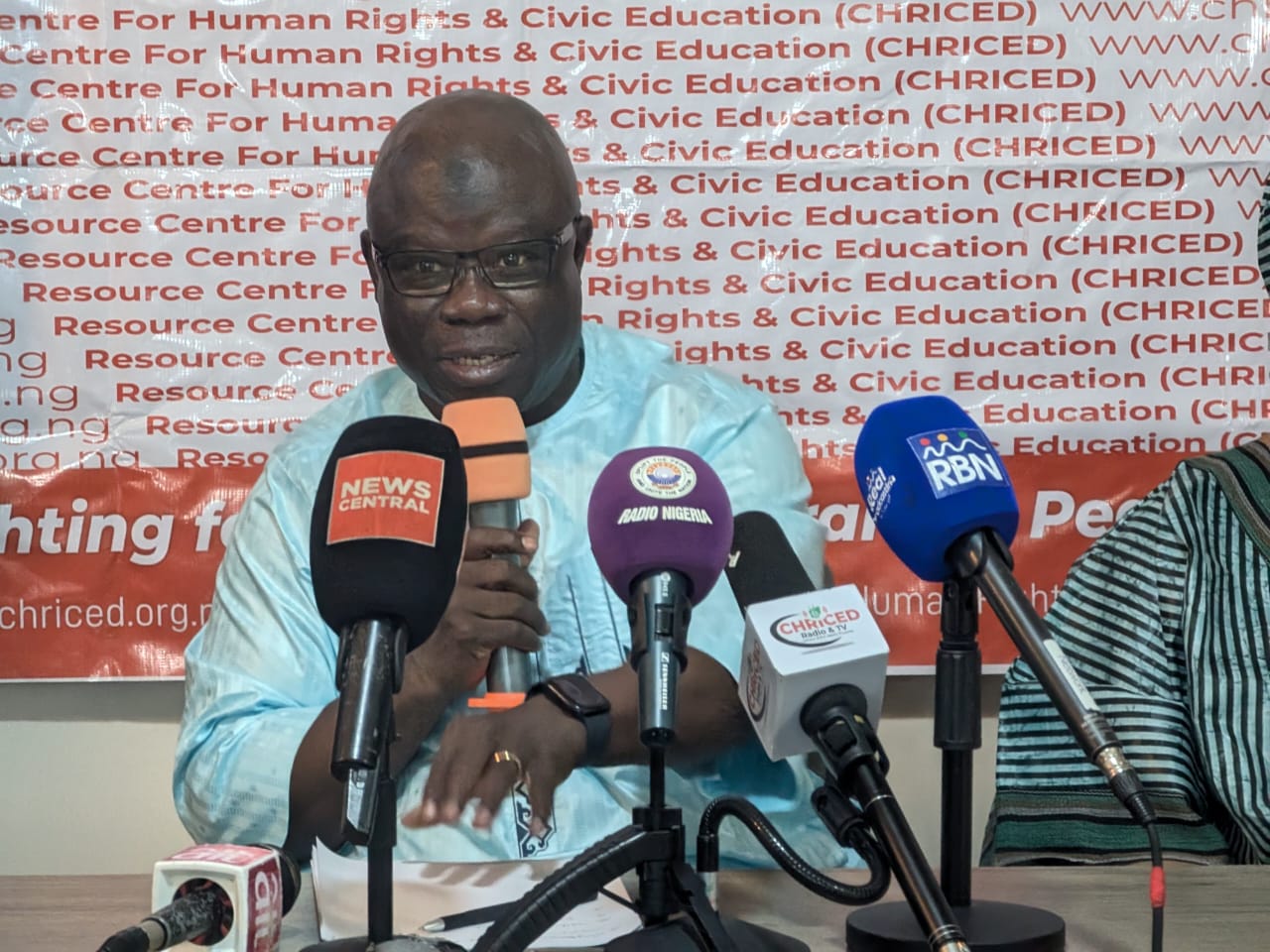
Speaking during a State of the Nation press briefing in Abuja on Tuesday, CHRICED Executive Director, Comrade Ibrahim M. Zikirullahi, alleged that the 2026 Appropriation Act contained several questionable allocations that undermine transparency, accountability, and effective public service delivery.
Zikirullahi said the most disturbing revelation was the allocation of projects unrelated to education under the N22.8 billion budget of the National Commission for Almajiri and Out-of-School Children Education.
According to him, billions of naira intended to address Nigeria’s growing out-of-school children crisis were instead earmarked for road construction, solar streetlights, and empowerment projects in different states.
Among the allocations highlighted by CHRICED are N1.4 billion for roads in Abeokuta, N1.05 billion for roads in Ipokia Ward 2, N1.4 billion for roads in Imeko and Idogo, N1.05 billion for internal roads in Katsina, N700 million for solar streetlights in Katsina, and another N700 million for women and youth empowerment tools.
“These are not education projects. They are diversions,” Zikirullahi said.
“It appears the government and politicians have become comfortable watching the children of the poor remain out of school. This is not just mismanagement—it is wickedness and inhumanity. At a time when bandits and insurgents prey on vulnerable children, the government is starving education to fund roads that may never be built,” he added.
The CHRICED Executive Director also criticised what he called the growing politicisation of Nigeria’s budget process, citing allocations of N8.05 billion for the construction and furnishing of churches and mosques through ministries and agencies whose mandates are unrelated to religious affairs.
He noted that the budget provided N6.14 billion for 52 mosque-related projects and N1.91 billion for seven church projects, while the Office of the Deputy Speaker allocated N780 million for church musical instruments.
“Why should scarce public funds be used to buy musical instruments when millions of Nigerians cannot afford food, have no jobs, and lack access to healthcare and education?” Zikirullahi queried, arguing that such expenditures run contrary to the spirit of Section 10 of the Constitution, which prohibits the adoption of a state religion.
He further questioned other controversial expenditures, including N500 million reportedly spent on an international communications campaign to counter allegations of religious persecution, a US$9 million contract awarded to a United States lobbying firm to improve Nigeria’s image abroad, and N6.44 billion allocated for FIFA World Cup qualifying activities despite Nigeria’s failure to qualify.
“Nigerians deserve answers, not excuses,” the rights advocate said.
On the country’s fiscal outlook, Zikirullahi expressed concern that Nigeria’s public debt has risen to ₦159.28 trillion, despite the removal of fuel subsidy, higher government revenues, and the introduction of new taxes.
“If revenues are performing above expectations, why are MDAs complaining of poor releases? Why is borrowing increasing? Why are annual budgets being extended into multiple years?” he asked.
He argued that the repeated extension of annual budgets into subsequent fiscal years has weakened legislative oversight and eroded the credibility of the country’s appropriation process.
The CHRICED Executive Director also warned against what he described as increasing attacks on democratic institutions and opposition political parties, saying reports of intimidation, disruption of political meetings, arbitrary arrests, and the alleged weaponisation of security agencies pose a serious threat to Nigeria’s democracy.
“A democracy without a vibrant opposition is not a democracy—it is an authoritarian project wearing democratic clothing,” he stated.
He called on President Bola Ahmed Tinubu to demonstrate stronger fiscal discipline and ensure prudent management of public resources. He also urged the National Assembly to restore integrity to the budget process, while calling on the Budget Office, the Office of the Auditor-General, the Independent Corrupt Practices and Other Related Offences Commission (ICPC), and the Economic and Financial Crimes Commission (EFCC) to investigate all allegations of budget irregularities.
According to Zikirullahi, civil society organisations, the media, professional bodies, and development partners must intensify efforts to promote transparency, accountability, and constitutional governance as the country prepares for the 2027 general elections.
“Nigeria stands at a crossroads,” he concluded. “Our democracy can only survive when transparency replaces secrecy, accountability replaces impunity, and public resources are used to improve the lives of citizens rather than serve narrow political interests.”